


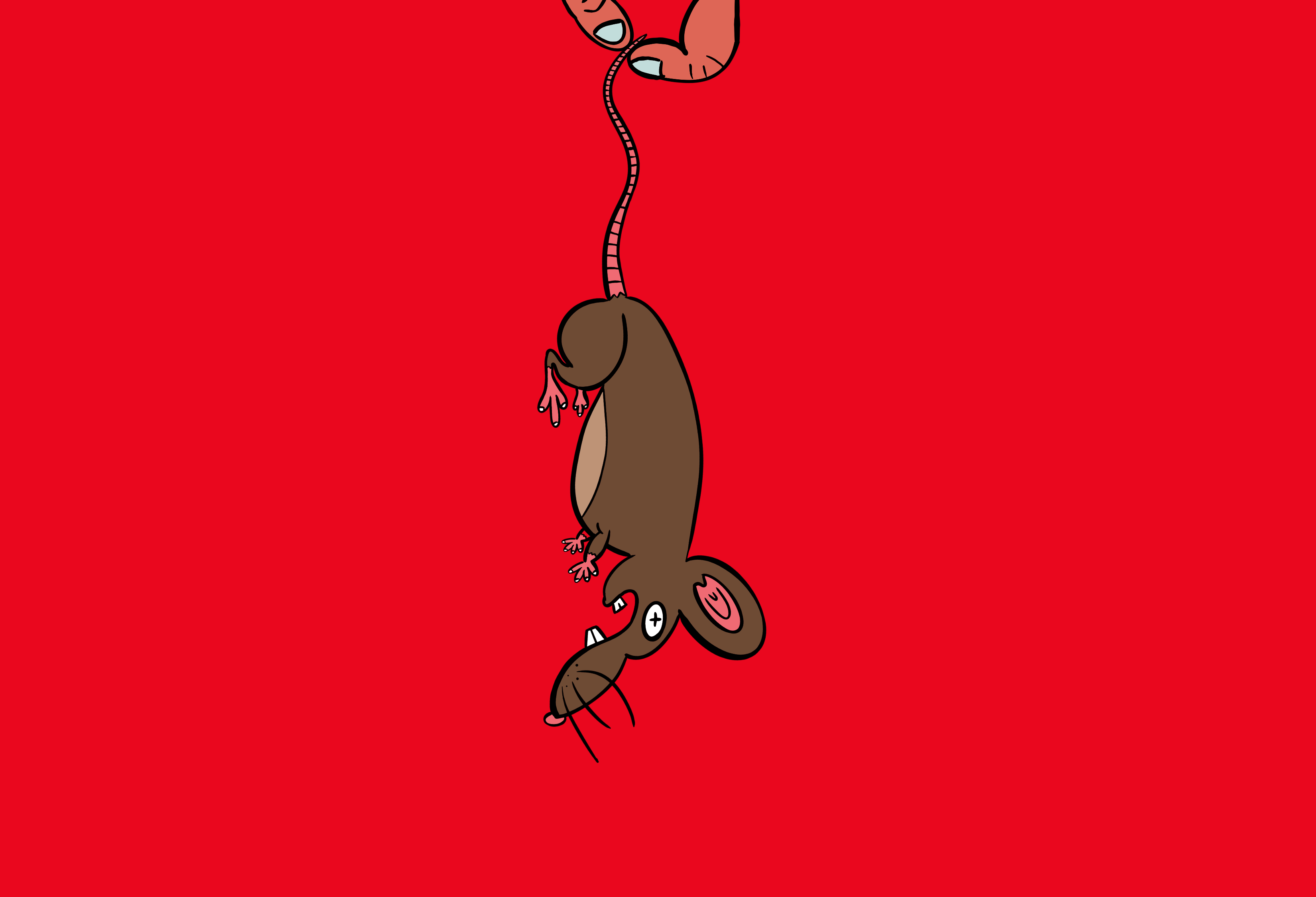
September 2021, Austin, Texas. Wake up, babe — the dead rat on your pillow is sizzling again. It’s time to give the world your opinion on intergenerational ethnosocioeconomic conditions.
If you’ve ever perused the top 10 channels on Twitch.tv (the most popular live-streaming platform on the internet, where online celebrities broadcast content directly to large audiences), you’ve likely come across a man who bears remarkably little resemblance to his contemporaries. Hawk-eyed and almost always wearing a soiled white t-shirt, Zack Hoyt has a face like one of those age-progressed renderings of kidnapped children from Dateline NBC.
A prolific streamer, a literal neckbeard, and the poster man-child for Chipotle-induced anemic malnutrition, Hoyt, also known as “Asmongold,” “Asmon,” or “The Roach King,” to his combined online audience of almost six million, is the spitting image of Beans from the Emmy-winning Disney Channel original television show Even Stevens — twenty years, a nasty divorce, and a midlife lupus scare later. He rose to fame via his witty World of Warcraft commentary, raw and unedited persona, and astounding open preference for filth and squalor — the pure spectacle of which has driven massive engagement with his stream.
When he’s not literally picking live roaches off his own shirt on camera, he doesn’t hesitate to share stories of his truly harrowing hygiene practices — like foregoing bathing for months to cultivate a protective “exoskeleton,” routinely wiping blood from his disintegrating gums directly onto the walls of his bedroom to avoid getting up for a cloth, “eating around” mold and maggots on forgotten food he rediscovers around his house, and almost never changing his rotting, yellowed pillowcases.
Perhaps most famously, he even once admitted on stream to purposely leaving a dead rat next to his bed to act “as an alarm clock,” waking him once the rising sun heated the carcass just enough to allow the scent of putrefying flesh and blowfly dung to once more grace his defiled nostrils.
But Asmongold’s mouldering home and neglect for his own health aren’t the only rotten things about him. He also has a penchant for unloading wilteringly poor political takes onto his credulous audience — despite hosting a stream purportedly dedicated to video games and related news.
“If there is one thing Asmon absolutely will not stand for, it’s the influence of DEI (i.e., ‘diversity, equity, and inclusion’) in games, a phenomenon which he contends exists only to serve as a hollow impediment to engrossing gameplay and competent storytelling.”
Much of Hoyt’s initial political toe-dipping could be explained by his uncompromising, all-consuming love for video games. It was this love, Asmon alleged, that drove him to finally speak out against the maleficent woke mind virus infecting his favorite hobby in the mid-2010’s and early 2020’s. That the rhetoric he employed in defense of gaming neatly reflected his wider worldview was, of course, merely a happy coincidence.
If there is one thing Asmon absolutely will not stand for, it’s the influence of DEI (i.e., ‘diversity, equity, and inclusion’) in games, a phenomenon which he contends exists only to serve as a hollow impediment to engrossing gameplay and competent storytelling. He reserves particular vitriol for character or storyline revisions intended to promote diversity in long-standing franchises, claiming that such changes alienate their most supportive fans.
Accordingly, in 2024, his first earnest foray into the political world was prompted by a controversy now known as GamerGate 2.0 (in reference to GamerGate, an earlier canon event in online gaming culture), which centered around Sweet Baby Inc., a company which provides consulting services to game studios in furtherance of promoting gender and racial diversity in game narratives.
At the time, groups of online reactionary activists, organized through web forums such as Kiwi Farms, 4chan, and Reddit, were on a years-long rampage against the perceived “woke agenda” in video games. Any game with prominent female or gay characters was regularly targeted and review-bombed, regardless of its mechanics, graphics, or storytelling. Accordingly, when a user named Kabrutus published a list of games associated with Sweet Baby on Steam (an online video game storefront that allows users to publicly curate game collections), this anti-woke community quickly mobilized, promoting boycotts of every game with which Sweet Baby had any involvement.
When Sweet Baby reported the list to Steam (correctly, for violating the platform’s code of conduct), the GamerGate 2.0 rose to the level of an organized harassment campaign against the company and its individual personnel — justified by popular creators like Asmongold as a righteous crusade against unethical censorship.
Unfortunately, Asmon’s pearl-clutching seemingly extends only to the purity of video game culture. Other appeals to morality appear to have almost no effect on him.

In reference to the (as of today, still-ongoing) Gaza genocide, Hoyt expressed extreme indifference in late 2024, opining that Palestinians were “terrible people” who were not owed his empathy due to their opposing religious and cultural beliefs. Although he later apologized for these statements, and even stepped back from leadership positions in the multiple companies he helmed, the controversy resulted in increased attention on his stream. The stage had been set for his full turn toward politics, with social and political commentary now comprising an increasingly significant portion of his content. Unfortunately, nowhere along the line did he bother to become any more educated on these new topics — as would soon become clear the following calendar year.
In March 2025, while live streaming, Hoyt called Congressman Al Green a “fucking retard” for interrupting Donald Trump’s joint address to Congress (Green shouted “You have no mandate to cut Medicaid” in protest of Trump’s support of the One Big Beautiful Bill Act). Later, he would go on to express more of his deeply-held beliefs: that transgender children are groomed “victims” of “mental[ly] ill” parents, that voter suppression is desirable and should be institutionalized, and that ICE should accelerate arrests and deportations (even going so far as to claim that ICE protestors should be punished with “compelled slave labor”).
As an encore to his strong showing for the year, Asmon went full mask-off in December, openly expressing support for neo-Nazi groyper and alleged pedophile James Fishback’s gubernatorial campaign in Florida.
But Asmongold is far from the only popular streamer parroting right-wing talking points under the guise of ‘moderacy’. An entire rogue’s gallery of internet personalities has found an audience (and thereby, a monetary pipeline) by appealing to the narrative that their viewerships are being held hostage by a culture which amplifies ‘radical left-wing’ beliefs to the detriment of their special interests.
“Although streamers like Asmongold, Sneako, and Adin Ross may not be fully aware of the impact of their actions on American culture, they damn well ought to be.”
“Sneako” — Andrew Tate disciple, muslim-larper, and popular children’s Kick streamer — has propagated enough anti-semitism online to earn himself a lifetime visa ban from Australia, openly praised authoritarian governments, and argued against the very concept of democracy. Adin Ross, who impressively built one of the largest and most ubiquitous streaming empires in the entire world despite his borderline illiteracy, threatened in 2024 to leave the U.S. if Trump lost the election and later hosted infamous neo-Nazi and white supremacist Nick Fuentes on his stream. Even “xQc”, the sixth-most followed Twitch streamer of all time, wore a Donald Trump campaign shirt in a 2024 live stream and provided an endorsement of the then-presidential candidate.
Sure, the algorithm rewards such alt-right opinions with more viewers — and appealing to conservative advertisers is an easier payday now than ever — but these guys sure do seem to really believe what they’re saying, too.
Interestingly, the so called ‘far-left’ views that act as the frequent object of these ‘moderate’ streamers’ derision seem to be, well, not quite so radical at all: support for common-sense causes like health care reform, increased corporate tax rates, protective climate policies, protections for gay and transgender rights, decreased costs for higher education, and heightened social safety nets.
Compare these positions to the views of the online far-right: white supremacy, ultra-nationalism, anti-humanism, traditionalism, hyper-masculinity — even Nazism, neo-feudalism and an obsession with the impending techno-monarchy.
The Overton Window has shifted, and celebrity personalities have overwhelmingly come to acknowledge the legitimacy of alt-right views (in large part thanks to the concerted efforts of clandestine political actors like Roger Stone and Steve Bannon). Such views have become increasingly accepted as normal, and even ‘centrist’ — despite how obviously conservative they might actually be — because political centrism has been successfully conflated with ideological moderacy in this country. Regressives are now conservative, conservatives are now moderate, and party-line democrats (neoliberal as they may be) are now, somehow, extremists.
Although streamers like Asmongold, Sneako, and Adin Ross may not be fully aware of the impact of their actions on American culture, they damn well ought to be. With such behemoth audiences and the near-undivided attention of the youth, they have a responsibility to care about more than just their bottom lines.
In a perfect world, regressives, monarchists, and flat-out Nazis such as these would be too ashamed to share their hateful opinions with polite society.
Instead, our cultural elites are more like the Front Section Passengers in Bong Joon Ho’s Snowpiercer: stupid, lazy, comfortable, entitled, greedy, consumeristic, and — more than anything else — entirely full of shit.
Don’t Be a Sucker is a blog about internet culture and its interactions with politics, law, and society at large. You can visit the Archive to read past entries. Subscribe below to make sure you don’t miss anything — and share this post if you enjoyed it. If you’re feeling particularly generous, consider buying us a coffee. This publication depends entirely on reader support.

God help us