


April 2022, the Bay Area, California. Some readers — depending on how chemically experimental their high school years were — may recall a mid-century American novel from freshman English class entitled The Butterfly Revolution. Usually assigned as a comparative analytical supplement to the much more popular (and less scandalous) Lord of the Flies, the book is about a summer camp whose teenage attendees successfully stage a violent mutiny and subsequently establish a semi-competent governing authoritarian state.
Even if you haven’t read William Butler’s 1961 classic, you might still recognize the now-infamous political theory with which the book shares a name — a political theory which singlehandedly molded the contemporary landscape of the American political right, served as the foundation for Project 2025, inspired the neofascist radicalization of prominent figures in business and politics like J.D. Vance, Peter Thiel, and Elon Musk, and influenced the second Trump administration to consolidate dictatorial authority over government.
And it’s actually much worse than it sounds.
Like the novel, Curtis Yarvin’s homonymous think piece focuses on the underlying motivations behind, and the consequences of, a carefully planned seizure of political power — but the two authors come to markedly different conclusions. Butler’s story is a cautionary tale about the dangers of authoritarianism, the corruptive nature of blind ideology, and the importance of safeguards on power. His subject revolution ends in abject tragedy: sexual assault, murder, and loss of innocence abound.
Meanwhile, Yarvin, a neo-feudalist, white supremacist, power fetishist who bears more than a passing resemblance to Grima Wormtongue from The Lord of the Rings, sees nothing the matter with autocracy.
He heralds a future in which a dictatorial Trump, acting with unchecked authority as “America’s chairman of the board,” succeeds in “truly mak[ing] America great again.” American representative democracy, he argues, is an inefficient form of government and a failed state; it should be replaced instead by a quasi-corporate monarchy, wherein the largest shareholders (“lords”) elect a sovereign dictator whose power is encumbered solely by his accountability to such lords.
Aside from being laughably asinine and comically evil, such a political system would be notably anti-liberalism, anti-democracy, pro-tyranny, and pro-suffering. Though Yarvin imagines a society in which such totalitarianism extends only to the political world (i.e., one in which social freedoms such as religious tolerance, same-sex marriage, and protection from discrimination are upheld), it seems naive to think that such a system — one which places all available power in the hands of a select few at the top of the economic system — would not result in the complete and timely erosion of all personal liberties, to the immediate benefit of oligarchs.
“[Yarvin’s] unique style of prose and unorthodox thinking — in concert with the intellectualized justifications he offered for technocapitalism — contributed in large part to [his] growing popularity”
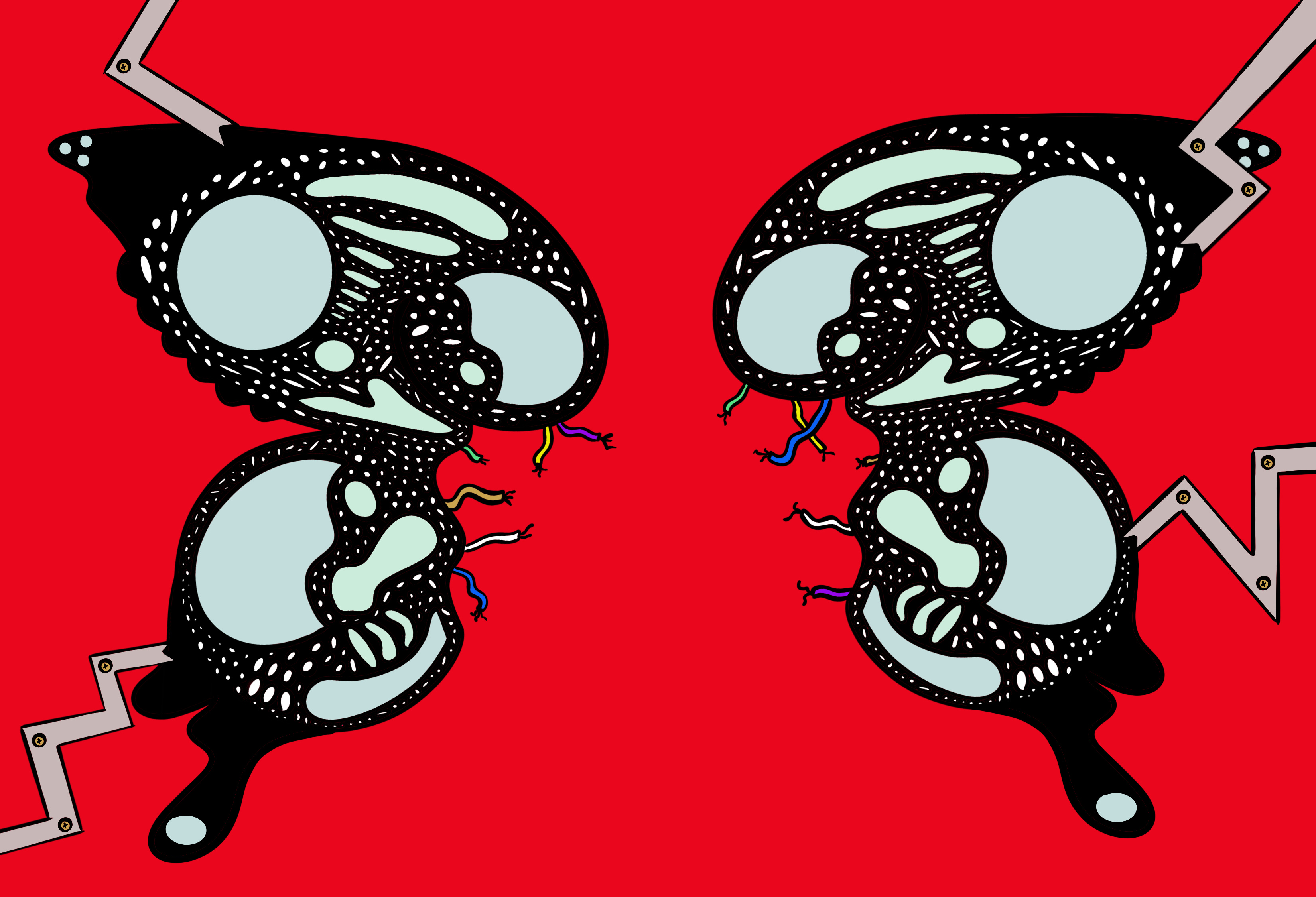
Yarvin’s Butterfly Revolution is a description of the process by which his neo-monarchy would be implemented. The Trump regime — at the time, still nursing its wounds from the 2020 election — would present itself as a “harmless caterpillar,” playing along with the expected behavior of a normative American political party.
Meanwhile, it would quietly accumulate an army of true believers: willing but inept stooges with “no prior political experience,” standing in wait to replace every existing government employee and, once deployed, carry out any and all of Trump’s dementia-and-diet-coke-addled whims. After finally regaining power, the caterpillar would emerge from its cocoon — now a glistening and triumphant butterfly — and weaponize its existing infrastructure to mortally wound democracy through entirely legal means.
Based on the striking similarities between Yarvin’s plot and that of the 1984 comedy classic Revenge of the Nerds, it should come as no surprise to discover how quickly his ideology was embraced by the Silicon Valley elites with which he rubbed shoulders in the early 2000’s — people like Peter Thiel, Marc Andreessen, and Balaji Srinivasan.
But Yarvin’s writing captivated a wider array of scumbags than just his own small circle of friends. His unique style of prose and unorthodox thinking — in concert with the intellectualized justifications he offered for technocapitalism — contributed in large part to the growing popularity of his blog, Unqualified Reservations. Offering up a tasteful blend of tongue-in-cheek neoconservative trolling, studied historical recall, and frankly, an absurdist and appalling worldview, the blog laid the groundwork for the burgeoning ‘classical liberalism’ subculture which would soon emerge in popular culture as a response to the rising tide of political correctness.
It also sparked a wave of faux-academic race realism among the online right, especially on 4chan, Hacker News and Reddit — some of the few social media platforms left which provide some amount of anonymity to users — where alt-right users did their best to amplify Yarvin’s views. For the avoidance of doubt, Yarvin claims that white people are generally smarter than black people, admits that he is “not exactly allergic to” white nationalism, and frequently voices his hearty disapproval of civil rights programs. His dicta also supports the existence of structural racism in America — usually implicitly, but he often says the quiet part out loud.
Perhaps that’s why he inspired such a cult following among the most prominent white nationalists in politics: people like disco-peptide vampire Thiel and his suspected sugar baby J.D. Vance, Breitbart boss Steve Bannon (a professional human botfly and the former campaign advisor to Trump), and — maybe most notably — Michael Anton, speechwriter for Rudy Giuliani and Robert Murdoch, managing director for BlackRock, Trump administration crony, and contributing architect for Project 2025.

Anton, when he’s not smoking brimstone cigarettes or kicking small children for pleasure, keeps in frequent contact with Curtis Yarvin. In 2017, Yarvin even gifted him a copy of one of his favorite contemporary texts: a regressive, 77-chapter, solipsistic manifesto called Bronze Age Mindset, written with intentionally poor grammar by a Yale Ph.D. graduate named Costin Alamariu.
Known online as “Bronze Age Pervert,” or sometimes just “BAP,” Alamariu is a far-right, reactionary eugenicist who subscribes to the so-called ‘Great Man’ theory, or the assertion that history can be explained by the presence and actions of singular ‘great men’ who drive the human race forward.
He gives great deference to the Nietzschean concept of the Übermensch, describing most men in contemporary culture as ‘bugmen,’ or docile, spiritually-cucked beta males who avoid conflict and risk in favor of comfort and security. The cause of this epidemic, BAP claims, is the rise of egalitarianism in western society — the development of powerful women has led to the production of less and less powerful men, as it were.
Students of history should recognize BAP’s eugenicism, his selective handling of Nietzsche, and his anti-pluralist, anti-egalitarian worldview as hallmarks of Nazism — likely a strong contributing factor as to why Anton wasn’t the only staffer in the Trump administration to appreciate Alamariu’s philosophy. After all, the Republican Party is chock-full of neo-Nazis that can’t help but continue to engage in public humiliation rituals.
Bronze Age Mindset was a global best seller and a particularly monumental hit on right-wing Capitol Hill, where it inspired a wave of young conservatives to fall over themselves at the chance of an internship with regressive think tanks like the Claremont Institute and the Heritage Foundation.
By now, you should have an inkling of what happened next: Alamariu’s unassuming clownery acted as a gateway for the more pernicious Yarvin to reach an audience of young, developing conservative elites in policy-making roles. The Heritage Foundation, which had been on the lookout for a new regressive demagogue to champion since Reagan began leaving his keys in the fridge and referring to the dog as ‘Nancy’ in the late 1980’s, found a path back to power with Donald Trump.
“It may be confusing to some that a person clearly as intellectually gifted as Curtis Yarvin — a man of virtually no renown, who was not born into significant wealth or status — would be content with the United States’ descent back into monarchy.”
Then, in 2022, shortly after Yarvin’s seminal article was published to his blog, the Heritage Foundation began preparing a roster of ideologically aligned civil servants (‘true believers’) as part of Project 2025, a policy blueprint for taking partisan control of the federal government via legal mechanisms. The Butterfly Revolution had begun in earnest.
Since then, things have gone more or less as Yarvin predicted. Trump ran a campaign which generally maintained the conservative status quo, and he managed to personally distance himself from the most unsavory ideas and thinkers behind his plans for reelection. He even went so far as to plainly deny any knowledge of Project 2025’s existence. Then, as soon as the presidency was once again in his mouldering, makeup-stained clutches, the caterpillar began its metamorphosis.
Among others things, Trump abruptly ended all DEI programs within the federal government and hired Elon Musk to slash the budget of vital scientific research and soft-power-generating-programs like USAID. He fired tens of thousands of dedicated federal employees and replaced them with his own loyalists. He stripped and neutered the Department of Education. He implemented mass immigrant roundups and deportations. He removed or weakened civil rights protections in connection with hiring and housing. He weaponized the Department of Justice against his political enemies and issued executive orders targeting law firms. He even exerted undue influence on the Supreme Court to make way for his regressive policies.
And we, the captive audience of this nonconsensual revolution, are unable to do anything but watch from below as the wings of Yarvin’s Butterfly unfold, spewing meconium and afterbirth directly into our frightened eyes.
It may be confusing to some that a person clearly as intellectually gifted as Curtis Yarvin — a man of virtually no renown, who was not born into significant wealth or status — would be content with the United States’ descent back into monarchy. Seemingly, a man such as he would stand to gain little to nothing from the implementation of his own revolution.
But Yarvin, like the Burma bandits described by Alfred in The Dark Knight, doesn’t have a coherent worldview. He isn’t looking to accomplish anything, or change the world for the better, or — clearly — even look good on camera. He didn’t plan his Butterfly Revolution because he was an ideologue — he did it because he was bored, and he thought it was funny.

Sadly — confusingly — heartbreakingly, “some men just want to watch the world burn.”
Don’t Be a Sucker is a blog about internet culture and its interactions with politics, law, and society at large. You can visit the Archive to read past entries. Subscribe below to make sure you don’t miss anything — and consider sharing this post if you enjoyed it.

Really good read. It's honestly kind of scary how well that butterfly metaphor fitsjust hiding the real goals until they actually get into power. Thanks for breaking this all down so clearly🤍.
I love your way of narrating the worldly events so effortlessly great while at the same time keeping it entertaining! You should have your own news segments; it won’t make the world problems disappear but at least it would make them slightly more enjoyable to listen to